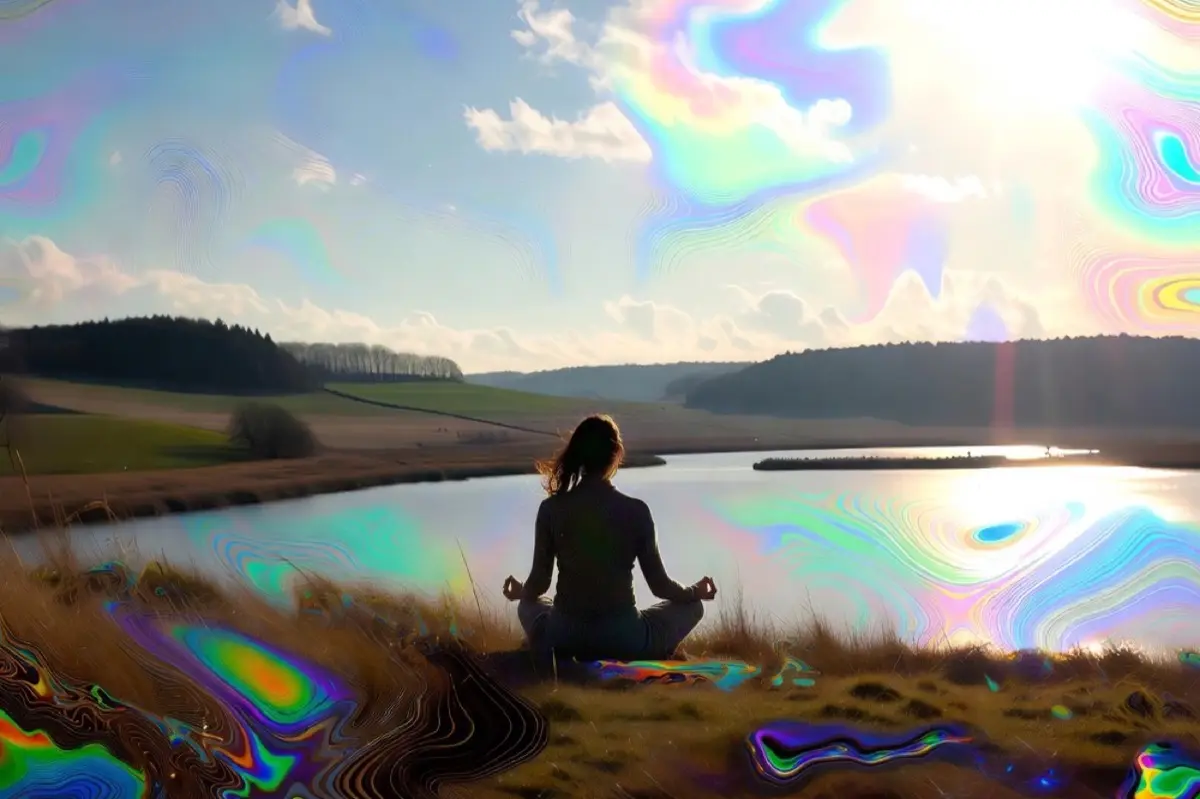



After a psilocybin retreat, many participants feel a renewed sensitivity to the natural world. Colors seem sharper. Birdsong registers differently. Wind on skin feels almost communicative. This is not merely poetic afterglow. It reflects real shifts in perception, and the outdoor environment can actively support the integration process that follows.
Integration, as explored in our piece on why the days after a session matter, is the sustained work of converting psychedelic insight into durable change. Walking in nature is one of the simplest, most accessible, and most evidence-supported ways to do that work. This article examines why, drawing on forest bathing research, polyvagal theory, nature connectedness studies, and practical guidance for the Dutch landscape where our retreats take place.
Forest bathing and the science of green immersion
The Japanese practice of shinrin-yoku (forest bathing) has been studied for over three decades. The basic protocol is simple: walk slowly through a forested area, engage the senses deliberately, and avoid task-oriented thinking. Research led by Qing Li and colleagues has shown that forest environments reduce salivary cortisol, lower blood pressure, increase natural killer cell activity, and shift autonomic nervous system balance toward parasympathetic dominance.
These physiological effects are not trivial for post-retreat integration. Psilocybin sessions can leave the nervous system in a state of heightened sensitivity. The calming influence of green environments helps restore a regulatory baseline from which deeper emotional processing becomes possible. You cannot integrate well from a state of chronic activation.
Nature connectedness and psychedelic openness
One of the most consistent findings in psychedelic research is that psilocybin increases the personality trait of openness to experience. A parallel finding, documented by Lyons and Carhart-Harris (2018), is that psychedelic use is associated with increased nature connectedness, the subjective sense that one belongs to and is interconnected with the natural world.
This is not a coincidence. Both openness and nature connectedness involve a loosening of the rigid boundary between self and environment. During a psychedelic session, that boundary may dissolve dramatically. During integration, nature walks offer a gentler version of the same experience: standing among trees, watching water move, noticing insects, and recognizing that you are part of, not separate from, a living system.
Research by Kettner et al. (2019) found that increases in nature connectedness after psychedelic experiences were linked to improvements in psychological well-being. Walking outdoors during integration may reinforce this shift before it fades.
Nervous system regulation: a polyvagal perspective
Stephen Porges' polyvagal theory describes three states of autonomic regulation: ventral vagal (safe social engagement), sympathetic (fight-or-flight), and dorsal vagal (freeze or shutdown). Healthy functioning requires fluid movement between these states, with ventral vagal as the default.
After a psilocybin session, people sometimes oscillate between states more readily than usual. Overwhelming content may push toward sympathetic activation or dorsal withdrawal. Nature environments, with their predictable sensory rhythms (birdsong, rustling leaves, flowing water), provide what polyvagal researchers call "neuroceptive cues of safety." These ambient signals help the nervous system settle toward ventral vagal without requiring conscious effort.
Walking adds a bilateral, rhythmic motor component that further supports regulation. The alternating left-right pattern of walking has been compared to the bilateral stimulation used in EMDR, though the mechanisms are distinct. What matters for integration is that gentle walking in a safe environment creates conditions where difficult emotions can surface and be processed without overwhelming the system.
Practical walking practices for integration
Not all outdoor walks serve integration equally. A brisk fitness walk with earbuds and a podcast is fine exercise, but it is not integration work. The following formats are more deliberately supportive.
Silent sensory walks
Walk for 20 to 40 minutes in a natural setting without music, podcasts, or conversation. Focus on one sense at a time: spend five minutes attending only to sounds, then five minutes on visual textures, then tactile sensations (wind, temperature, ground underfoot). This practice trains present-moment awareness and interrupts ruminative thought loops.
Walking meditation
Slow your pace to roughly half your normal speed. Coordinate breath with steps: inhale for three steps, exhale for four. Notice the micro-movements of each foot as it lifts, moves forward, and contacts the ground. This format is especially useful when emotional intensity is high and sitting meditation feels too confrontational.
Reflective walks with a single question
Before leaving, choose one question from your integration work (for journaling ideas, see our 30-day prompt guide). Hold that question lightly as you walk. Do not force answers. Allow images, memories, or feelings to arise in response. Many people find that movement unlocks associative thinking that sitting does not.
Walking with a companion
Shared silent walks followed by brief verbal reflection can combine the benefits of solo practice with the relational grounding described in our article on integration circles versus solo work. The key is to walk in silence first and talk after, not during.
The Dutch landscape as integration terrain
The Netherlands is not often associated with wild nature, but its landscapes offer distinctive integration value. Within an hour of most retreat locations, participants can access multiple biomes.
The coastal dunes (duinen) along the North Sea provide wide horizons, ocean sounds, and exposure to open sky. These sensory qualities can support participants who feel constricted or overwhelmed, offering spaciousness as a physical metaphor.
Forest areas such as the Veluwe, Lage Vuursche, and Amsterdamse Bos offer dense canopy, filtered light, and the acoustic dampening that shinrin-yoku research emphasizes. These environments are well suited for slow sensory walks and walking meditation.
Polders, the flat agricultural landscapes reclaimed from water, offer a different quality: simplicity, repetition, and long sight lines. Walking along a canal with no destination can mirror the open-ended quality of integration itself, where the point is not arrival but attention.
Even urban parks and canal paths can serve integration needs. What matters is the deliberate shift from task mode to sensory presence, not the wilderness rating of the location.
Seasonal considerations
Integration walks are a year-round practice, but each season offers different qualities. Spring brings rapid visible growth, which can mirror the sense of new possibility many participants feel. Summer provides warmth and longer daylight, reducing barriers to getting outdoors. Autumn, with its falling leaves and shortening days, can support the processing of loss and letting go. Winter walks in bare forests offer starkness and silence that may suit deeper, more contemplative work.
Dutch winters are cold and grey, which can deter outdoor time. Participants integrating during winter months benefit from committing to even brief daily outdoor exposure (15 to 20 minutes) rather than waiting for ideal conditions. Research by Bratman et al. (2015) found that even a 90-minute walk in a natural setting reduced rumination and neural activity in the subgenual prefrontal cortex, a region associated with repetitive negative thinking. Shorter walks still help.
Combining nature walks with journaling
A powerful integration rhythm involves three steps: walk, sit, write. After a 30-minute sensory walk, find a quiet spot to sit for five minutes in stillness, then write freely for 10 to 15 minutes. This sequence uses the walk to surface material, the pause to let it settle, and the writing to capture and structure what emerged.
Some participants carry a small notebook and pause during walks to record single words or images. This "field note" approach prevents the loss of fleeting impressions that often carry integration value. The key is to keep writing brief and associative during the walk, reserving longer reflection for afterwards.
Why nature mirrors the psychedelic experience
Several qualities of natural environments echo the phenomenology of the psilocybin experience, which may explain why nature walks feel so supportive during integration.
Impermanence. Everything in nature is in process: clouds forming and dissolving, tides shifting, leaves growing and falling. This visible impermanence can help participants accept that their own post-retreat states (euphoria, confusion, grief, clarity) are also temporary and part of a larger cycle.
Interconnection. Ecosystems display constant mutual influence. Mycelial networks connect trees underground. Pollination links plants and insects across distances. Seeing interconnection in nature reinforces the felt sense of unity that many people report during psilocybin sessions.
Beauty without purpose. Nature provides aesthetic experiences that are not designed, marketed, or optimized for human consumption. This purposeless beauty can remind participants that meaning does not require productivity, a realization that often emerges during psychedelic experiences but struggles to survive in daily life.
Scale. Old trees, ocean horizons, and star-filled skies provide contact with timescales larger than a human life. This perspective, similar to the "overview effect" described by astronauts, can help participants hold their personal struggles with greater equanimity.
Research on nature exposure and mental health outcomes
The integration benefits of nature walks are supported by a broad evidence base beyond psychedelic-specific research. A meta-analysis by Twohig-Bennett and Jones (2018) found that nature exposure was associated with significant reductions in cortisol, heart rate, diastolic blood pressure, and the incidence of type 2 diabetes, stroke, and cardiovascular mortality. Mental health effects included reduced depression, anxiety, and insomnia.
White et al. (2019) found that spending at least 120 minutes per week in nature was associated with substantially higher self-reported health and well-being. The threshold effect suggests that even two dedicated integration walks per week could deliver meaningful benefits.
For post-retreat participants, these findings converge: nature walks reduce the physiological stress load that can interfere with integration, while simultaneously promoting the reflective, open, connected state of mind that integration requires.
Making it practical
Integration walks do not require elaborate planning. A few principles help.
Start within the first three days after your retreat, when perceptual sensitivity is still elevated. Aim for at least three walks per week during the first month, each lasting 20 minutes or more. Choose settings with natural elements (trees, water, open sky) over purely urban routes when possible. Leave your phone on silent or at home. Walk alone at least half the time. Vary your routes to prevent habituation.
If you attended one of our retreats, your facilitator can suggest specific nearby locations suited to integration walking. Many participants find that establishing a "home route" (a familiar path they return to repeatedly) provides both comfort and the ability to notice subtle changes in perception over time.
Nature walks are not a replacement for professional support when it is needed. They are a complementary practice that works alongside journaling, integration circles, and, where appropriate, therapy. Their power lies in their simplicity: you step outside, you slow down, you pay attention. The natural world does the rest.
UNLOCK THE MIND. ELEVATE THE SELF.