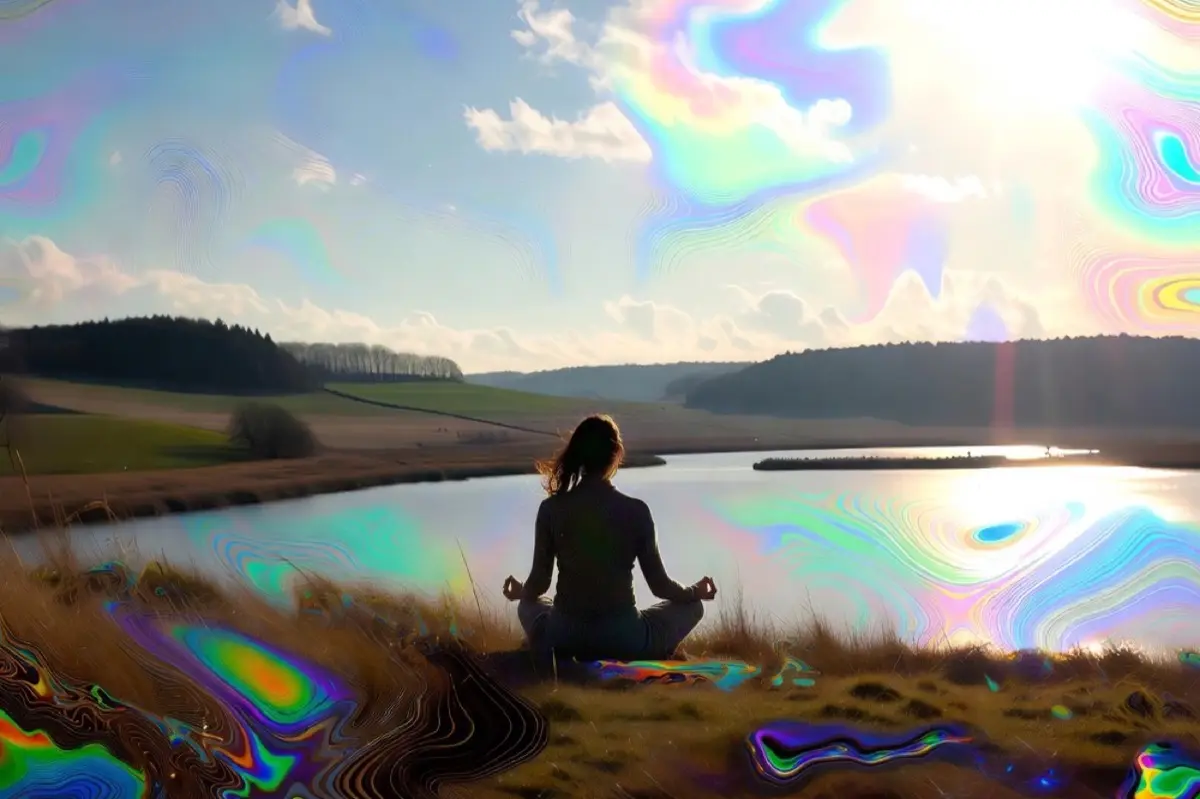



Among the most common questions we receive from retreat participants is this: "I don't meditate regularly. Will that put me at a disadvantage?" The short answer is no, it won't disqualify you from a meaningful experience. But the longer answer reveals something fascinating about how contemplative practice and psychedelics interact at the level of the brain, the body, and the sense of self.
What the research actually shows
A landmark 2018 study from Johns Hopkins, led by Roland Griffiths and colleagues, examined how meditation practice interacted with psilocybin in a group of long-term meditators. The findings were striking: participants who combined psilocybin with a meditation retreat reported significantly greater persisting positive changes in attitudes, behaviour, and spirituality than those who received psilocybin alone (Griffiths et al., 2018, Psychopharmacology). The combination appeared synergistic rather than simply additive.
However, it would be a mistake to conclude that years of meditation are a prerequisite. A separate line of research from the Imperial College Centre for Psychedelic Research has shown that the key variable predicting positive outcomes is not meditation experience per se, but the psychological quality that meditation cultivates: the capacity to accept whatever arises without resistance.
The skill that matters most: surrender
What meditation trains, more than anything else relevant to psychedelic work, is the ability to observe experience without immediately reacting. In Buddhist psychology this is called equanimity. In clinical psychedelic research, it maps closely onto what researchers call "surrender" or "letting go," which the Mystical Experience Questionnaire identifies as one of the strongest predictors of lasting therapeutic benefit.
This is why meditation matters for psilocybin preparation: not because it creates some exotic brain state, but because it trains a relationship to experience that proves invaluable when the psychedelic dissolves ordinary reference points. If you have practised sitting with discomfort, with uncertainty, with the urge to escape, you carry that capacity into the session.
Types of meditation and their relevance
Not all meditation practices serve the same preparatory function. Here is how the most common approaches relate to psychedelic readiness:
Mindfulness (focused attention and open monitoring)
The most extensively studied form, mindfulness meditation trains two complementary skills. Focused attention (typically on the breath) builds the capacity to anchor awareness during moments of intensity. Open monitoring, where you observe thoughts and sensations without selecting any particular object, directly rehearses the receptive stance needed during a psilocybin session. Research from Lutz et al. (2015) demonstrates that even brief mindfulness training produces measurable changes in how the brain processes emotional stimuli.
Loving-kindness (metta) meditation
This practice, which involves generating feelings of warmth toward oneself and others, appears particularly relevant for participants who carry self-critical patterns. Psilocybin frequently amplifies whatever emotional tone is present at the outset. Arriving with a practised sense of self-compassion can shift the entire trajectory of a session. A 2013 study in Psychological Science found that loving-kindness practice increased positive emotions and built personal resources over time, even in novice practitioners.
Body scan and somatic awareness
Psilocybin is not exclusively a mental experience. Many participants report intense bodily sensations, energy movement, or physical release. Body scan meditation, where attention moves systematically through regions of the body, trains the ability to stay present with physical intensity rather than interpreting it as something wrong. This can be especially helpful during the onset phase of a session, when unusual body sensations sometimes trigger anxiety in unprepared participants.
What if you've never meditated?
Here is the encouraging finding: you do not need years of practice. Research on meditation interventions consistently shows that meaningful shifts in attention regulation and emotional reactivity can occur within two to four weeks of daily practice, even sessions as short as ten minutes (Zeidan et al., 2014). The neural circuits involved in attention and emotional regulation respond relatively quickly to training.
For participants approaching a retreat with no prior meditation experience, we suggest a simple graduated approach:
- Weeks 1-2: Five to ten minutes of breath-focused attention daily. Simply notice when the mind wanders and gently return.
- Weeks 3-4: Extend to fifteen minutes. Introduce open monitoring: after settling with the breath, relax the focus and observe whatever arises (sounds, sensations, emotions) without engaging.
- Final week: Add a brief loving-kindness phrase at the end of each sit: "May I meet whatever comes with openness."
This minimal programme builds the three most relevant capacities: attentional stability, non-reactive observation, and self-compassion. You can read more about complementary preparation approaches in our guide on intention setting that actually helps.
How meditation shifts "set"
In psychedelic research, "set" refers to the psychological state you bring to the experience: your expectations, your emotional baseline, your beliefs about what will happen. Meditation influences set in several important ways:
First, regular practice tends to reduce anticipatory anxiety. The meditator has rehearsed, hundreds of times, the act of noticing fear and choosing not to flee. This creates a baseline of psychological safety that transfers into novel situations.
Second, meditation loosens identification with thought content. Experienced practitioners often report that thoughts become "events in the mind" rather than commands that require obedience. During a psilocybin session, when the mind generates unusual or challenging content, this decentered perspective can prevent the spiral into panic that sometimes occurs when people take disturbing thoughts at face value.
Third, meditation creates familiarity with altered states. Even without substances, deep meditation can produce experiences of boundary dissolution, time distortion, or perceptual shifts. For the regular practitioner, the territory revealed by psilocybin is not entirely unfamiliar, which reduces the shock response. A 2019 comparison study from the University of Geneva found overlapping neural signatures between advanced meditation and moderate-dose psilocybin experiences, particularly in regions associated with self-referential processing.
When meditation might not help (or could hinder)
Honesty requires acknowledging that meditation is not always beneficial preparation. In certain cases, a meditation practice can actually create obstacles:
Rigid concentration practices: Some traditions emphasise intense, narrow focus (certain jhana practices, for example). If a practitioner brings this controlling orientation into a psilocybin session, attempting to "steer" the experience through willpower, they may struggle with the inherently uncontrollable nature of the psychedelic state. The attempt to maintain meditative control can create friction rather than ease.
Spiritual bypassing: Practitioners who use meditation to avoid difficult emotions (staying "above" anger, grief, or fear rather than meeting them) may find psilocybin uncomfortably confronting. The substance tends to surface precisely what has been suppressed, regardless of how skilled the suppression.
Performance orientation: Meditators who approach their practice with achievement goals ("I should reach this state") may unconsciously bring the same orientation to the psychedelic session, creating expectations that interfere with organic unfolding.
The antidote in each case is the same: approach both meditation and the psilocybin experience with curiosity rather than mastery. The goal is not to "meditate well" during the session but to have cultivated a general willingness to be present with whatever appears.
Practical integration: meditation and retreat preparation
At our retreat centre, we incorporate brief guided meditation into the preparation process, precisely because it bridges the gap between everyday consciousness and the receptive state that supports deep work with magic truffles. Whether you arrive with twenty years of Vipassana training or twenty minutes of YouTube-guided breathing, the underlying invitation is the same: can you meet this moment as it is?
We also recommend reviewing our guidance on pre-retreat diet and nutrition, as physical preparation supports the same qualities of lightness and openness that meditation cultivates on the mental plane.
The bottom line
Does meditation change the psilocybin experience? The evidence suggests yes, particularly in three domains: depth of mystical experience, ease of navigating difficult passages, and persistence of positive changes afterward. But the relevant factor is not the quantity of meditation hours logged. It is the quality of presence you have cultivated, the willingness to be with experience rather than against it.
Even a brief, sincere practice begun a few weeks before your retreat can shift your relationship to uncertainty, discomfort, and the unknown. That shift may be the single most valuable thing you bring into the session room.
UNLOCK THE MIND. ELEVATE THE SELF.